
For most of 2024 and 2025, Apple was the company everyone assumed had missed the AI wave. The demos slipped, the smarter Siri was quietly delayed, and the running joke was that the most advanced AI on an iPhone came from someone else's app. At WWDC 2026, that story changed.
Apple introduced the third generation of its Apple Foundation Models, a rebuilt Siri, and a developer framework that hands the same models to anyone building an app. It was not a flashy attempt to out-shout the rest of the industry. It was the quiet, deliberate comeback of a company that decided to win on its own terms: private, on-device first, and genuinely useful. Here is what actually changed, and why it matters if you run a business.
From Stumble to Strategy
When Apple Intelligence was first announced in 2024, the promise ran ahead of the product. The next-generation Siri that was supposed to understand your personal context kept slipping, and the gap between the keynote and what shipped became impossible to ignore. Reporting later described a pivotal internal reset in early 2025 that put the whole effort on a new course.
Instead of rushing a half-ready assistant out the door, Apple spent 2025 rebuilding the foundation underneath it, then came back at WWDC 2026 with something that works. The lesson here is not really about Apple. It is about the difference between announcing AI and shipping AI that people can actually rely on, which is the exact problem most companies are wrestling with right now.
The New Foundation Models, in Plain English
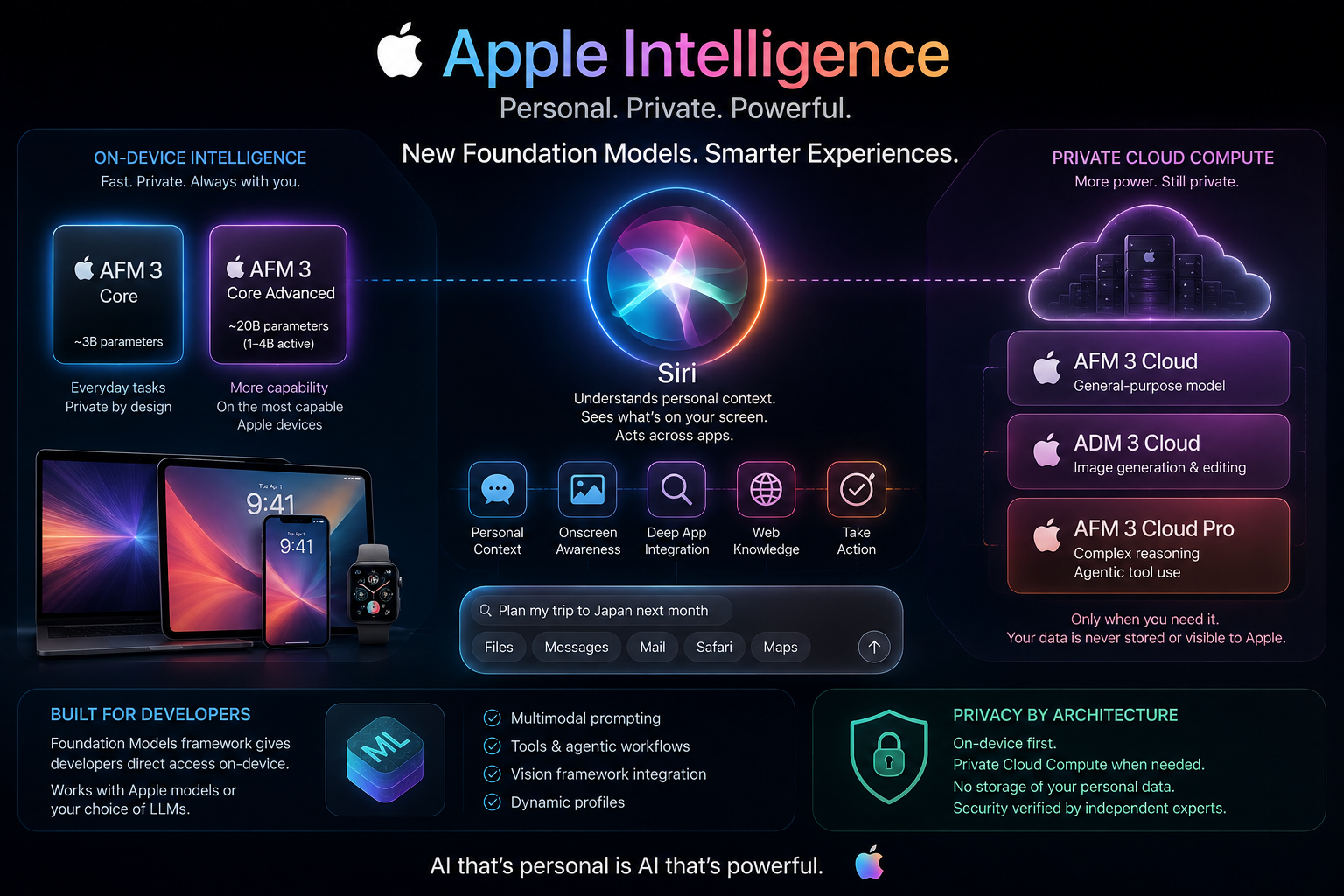
The engine behind the comeback is a family of five custom models Apple calls the third generation of Apple Foundation Models, or AFM 3. Rather than one giant model that does everything, Apple built a set of specialists and a system that routes each request to the right one. Some run directly on your device, and some run in the cloud only when a task truly needs the extra horsepower.
AFM 3 Core
A roughly 3 billion parameter on-device model for everyday text tasks. Fast, private, and always available even without a connection.
AFM 3 Core Advanced
A roughly 20 billion parameter multimodal model that also runs on device, handling text, images, and audio on the most capable Apple hardware.
AFM 3 Cloud
The general purpose server model for heavier reasoning, running inside Apple's Private Cloud Compute.
ADM 3 Cloud
A dedicated image model powering generation and editing features like Image Playground and Genmoji.
AFM 3 Cloud Pro
The most capable model, built for complex reasoning and agentic tool use, reserved for the hardest requests.
One detail worth clearing up, because it made a lot of headlines: these are Apple's own models, not a rebadged version of Google Gemini. Apple did use Google's models during the training process to help refine its own, and the top-tier Cloud Pro model runs on NVIDIA hardware inside Google Cloud, but the models answering your requests are Apple's.
A 20 Billion Parameter Model on Your Phone
The most impressive technical achievement is AFM 3 Core Advanced. A 20 billion parameter model is the kind of thing that normally lives in a data center, yet Apple gets it running on a phone through a clever trick. The full model sits in the device's flash storage, and for any given request a lightweight component reads your prompt and loads only the small slice of the model, between 1 and 4 billion parameters, that is actually relevant.
The payoff is not the parameter count. It is what that unlocks: capable, multimodal AI that runs locally, works offline, and never sends your data anywhere. For anyone who has hesitated to put sensitive information into a cloud AI tool, on-device processing quietly removes the biggest objection.
Private Cloud Compute: Power Without Surveillance
Not every task fits on a phone. When a request needs more reasoning power, it goes to Private Cloud Compute, Apple's server layer for AI. The design goal is to give you cloud-scale capability without the usual cloud-scale trade-off of handing over your data.
Private Cloud Compute is built to be stateless and cryptographically verifiable. Your data is used to answer the request and then discarded, it is not stored, and it is not visible to Apple. Independent security researchers can inspect the system to confirm those claims. Even the most powerful Cloud Pro model, which runs on NVIDIA GPUs inside Google Cloud, is wrapped in these same privacy protections.
The important shift is architectural. Apple did not add privacy as a policy on top of a cloud AI service. It designed the system so the data is never there to leak in the first place.
Siri, Finally
The most visible result of all this is Siri AI, the assistant Apple has been promising since 2024. This is a full redesign, not a patch. Siri can now hold a real conversation, understand your personal context across apps, see what is on your screen, and take action on your behalf. Here is what that looks like in practice:
Personal context, pulling relevant details from your email, messages, photos, and files to answer questions that used to require you to go dig them up yourself.
Onscreen awareness, so it can act on whatever you are looking at, like adding an address from a text straight into your contacts.
Cross-app orchestration, carrying out multi-step tasks that span several apps instead of stopping at a single command.
Natural conversation, remembering what you just said so you can ask a follow-up without repeating yourself.
This is the jump from an assistant that answers questions to one that gets things done. It is the same agentic pattern reshaping business software, now sitting in everyone's pocket.
Handed to Developers, for Free
The quietest announcement may be the most consequential. Through the Foundation Models framework, Apple gives developers direct access to the same on-device and cloud models, using a single, consistent interface. An app can run a task locally for privacy and speed, then reach into Private Cloud Compute for a harder request, all without the developer managing API keys or servers.
Why the pricing matters
For eligible developers in the App Store Small Business Program with under 2 million downloads, access to Apple's cloud models carries no per-token cost. Advanced AI that used to require a budget and a cloud contract is now a built-in platform feature, which will pull a wave of smaller apps into shipping real AI capabilities.
Apple also added conveniences that make this genuinely usable: multimodal prompting, adjustable reasoning levels so developers can trade speed for depth, dynamic profiles for building agent-style experiences, and an evaluations framework to measure whether an AI feature is actually improving. A Python SDK and Linux support signal that Apple wants the broader AI community building here, not just its traditional app developers.
Other AI Systems Can Now Talk to Your Phone
This is the change almost nobody saw coming, and it may be the most important one. For years, Apple's assistant was a sealed box. Outside AI systems could not reach into it, and Siri could not be swapped out or extended. That wall came down.
With Apple Intelligence Extensions in iOS 27, you can now choose which AI model sits behind Siri. Anthropic's Claude, OpenAI's ChatGPT, Google's Gemini, and xAI's Grok can each be selected in Settings as the provider powering Siri, Writing Tools, and Image Playground. Siri becomes the orchestration layer and the interface, while the model you picked does the thinking. Apple went from having one exclusive AI partner to running a marketplace on top of more than two billion devices.
The piece that makes it real: App Intents
Apple deprecated the old SiriKit and made App Intents the required contract between apps and the system AI. Apps publish their actions and their data as structured intents, and the assistant can chain them together across multiple apps. App Intents 2.0 adds streaming progress on long tasks, multi-turn follow-up questions when a request is ambiguous, and onscreen awareness so the assistant knows what "this one" refers to. If your app does not publish intents, the assistant simply cannot see it.
Put those two together and you get something that genuinely was not possible before: an external AI assistant that can be reached through your phone and can actually take action across your apps, rather than just returning text you have to act on yourself. Alongside this, agentic desktop tools like Anthropic's Claude Cowork and the coding agents now built into Xcode 27 mean the same models you work with on a laptop are increasingly the models running on your phone.
One honest caveat worth knowing, because it gets misreported: Apple did not open Siri up to the Model Context Protocol system-wide. MCP support landed in Xcode 27 so coding agents can connect to tools like GitHub and Figma. At the OS level, the path in is the Extensions framework and App Intents, not MCP. That distinction matters a lot if you are planning an integration.
Data Sovereignty: The Real Business Story
Data sovereignty is the question of where your data physically lives, who is legally able to reach it, and which country's laws apply to it. For a long time that was a concern for banks and hospitals. Now it applies to any business that touches client information and uses AI to process it, which is very close to all of them.
Apple's architecture gives you a genuinely useful answer, and it is worth understanding the three tiers:
On-device processing is the strongest form of sovereignty available in a consumer product. The data never leaves the hardware, so there is no transfer to disclose, no processor to contract with, and no jurisdiction question to answer. For sensitive work, this is the tier you want.
Private Cloud Compute is a strong middle ground. Data is not retained, is not visible to Apple, and the system is cryptographically verifiable by outside researchers. Apple also publishes an Apple Intelligence Report so you can see which requests left the device.
Third-party extensions are the tier to watch. The moment a request is routed to an outside provider, that provider's privacy policy and data handling govern it, not Apple's. Convenience and sovereignty pull in opposite directions here.
Where this gets complicated for regulated businesses:
It is still a vendor-controlled cloud. However well designed, Private Cloud Compute is infrastructure you cannot physically audit and do not control the model weights for. Under frameworks like the EU AI Act, NIS2, or DORA, that can fall short of a strict sovereign AI standard.
The routing is invisible. A request escalates from device to cloud automatically based on complexity, not based on how sensitive the content is. For GDPR obligations around processing agreements and transfer assessments, "it depends on the prompt" is a hard position to document.
Geography still rules. Availability varies by jurisdiction. Apple Intelligence does not operate on mainland China accounts, and the EU rollout was delayed over Digital Markets Act questions. If you operate across borders, your AI capabilities are not uniform.
The practical takeaway is not "trust it" or "avoid it." It is to classify your workloads. Decide in advance which categories of data are allowed to leave a device, which may go to a verifiable private cloud, and which may never be handed to a third-party model at all. Then configure your tools to match that policy instead of hoping defaults protect you.
This is why the on-device tier matters so much commercially. It is the first time a mainstream platform has made capable AI available with a defensible answer to "where did our client's data go?" For firms handling legal, medical, or financial information, that answer is quickly becoming a requirement rather than a nice-to-have.
What This Means for Your Business
You are not going to run your company on Siri. The reason this release matters to a business owner is the pattern it confirms, and the expectations it sets with your customers and your team.
Three takeaways worth holding onto:
Privacy is now a feature you can sell. Apple just made on-device and verifiable private AI a mainstream selling point. If you handle client data, being able to say where it goes and who can see it is becoming a real competitive advantage.
Agentic is the new baseline. When customers get used to an assistant that takes action across apps, a contact form that just sits there will start to feel dated. The bar for what software should do is rising fast.
Shipping beats announcing. Apple's comeback came from fixing the foundation and delivering something reliable, not from a bigger keynote. The same discipline is what separates businesses getting real value from AI from those still stuck in pilot mode.
The Bottom Line
Apple's return to the AI conversation is not about winning a benchmark war. It is about proving that the AI people actually adopt is the AI that is fast, private, and built into the tools they already use. A 20 billion parameter model running on a phone, a cloud that forgets your data on purpose, and an assistant that finally does things instead of just answering, together they mark the moment Apple's AI stopped being a punchline.
The technology is no longer the hard part.
Deciding where it actually earns its keep in your business is.
Want AI that works like Apple's does, private, practical, and built in?
Our Infrastructure Audit pinpoints exactly where AI can amplify your team without adding risk or busywork. No hype, just the workflows worth automating.
Request Your Infrastructure Audit →