
The conversation around artificial intelligence has fundamentally shifted. After two years of breathless headlines about ChatGPT, trillion-dollar valuations, and promises of AGI right around the corner, February 2026 marks a sobering pivot: AI is finally growing up.
The change isn't about the technology getting worse, it's about expectations catching up with reality. And for mid-market business owners still trying to figure out whether AI is a genuine opportunity or just another tech fad, this shift changes everything.
The Party's Over (And That's Actually Good News)
Industry experts are calling 2026 the year AI moves from "hype to pragmatism." After spending billions on infrastructure buildouts and watching startup valuations soar into the stratosphere, investors and executives alike are asking a simple question: Where's the actual value?
The answer is starting to emerge, but it looks different than the sci-fi promises suggested.
"AI won't just summarize papers or answer questions anymore. It's becoming something more tangible, more useful, and frankly, more boring in the best possible way. It's becoming a tool that actually integrates into how work gets done."
Peter Lee, Microsoft Research President
AI Agents: The New Junior Employee (Sort Of)
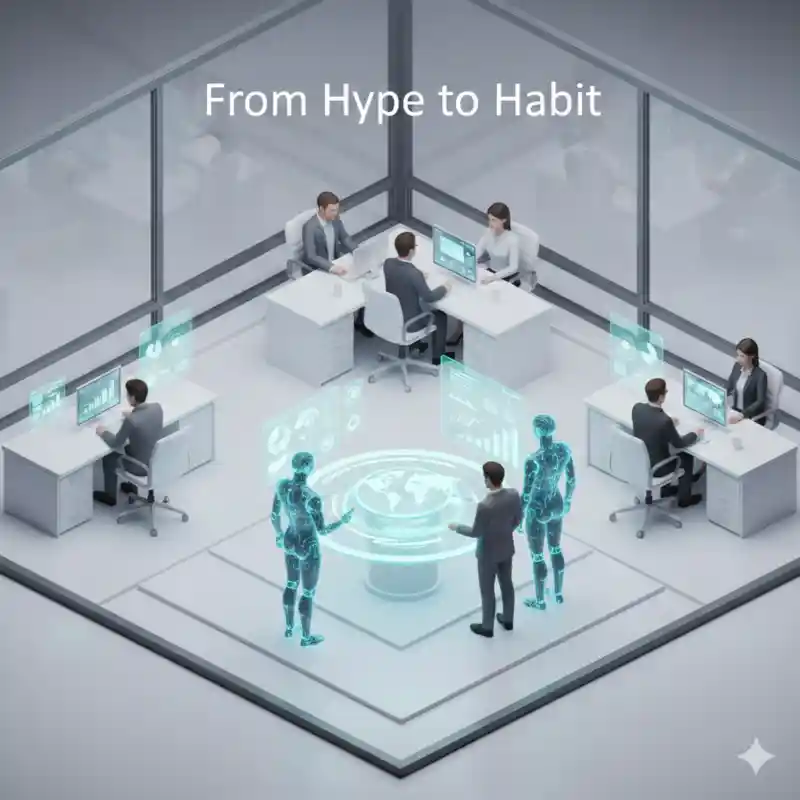
The biggest trend dominating February 2026 is the rise of "agentic AI", systems designed to act more like digital coworkers than passive tools. Microsoft's Aparna Chennapragada envisions a workplace where a three-person team can launch global campaigns in days, with AI handling data analysis, content generation, and personalization while humans focus on strategy and creativity.
McKinsey's AI Workforce Reality
McKinsey now operates with what CEO Bob Sternfels calls a virtual "workforce" of 20,000 AI agents alongside 40,000 human employees. They've even introduced an "AI interview" stage for graduate recruitment, where candidates must demonstrate their ability to work with their internal AI tool, "Lilli."
But here's the critical insight that most headlines miss: these agents aren't replacing workers, they're amplifying them. Vasu Jakkal from Microsoft Security emphasizes that organizations must treat AI agents like human employees when it comes to security, access controls, and accountability. Every agent needs a clear identity and defined permissions.
The Hard Truth About AI Implementation
Despite the excitement, experts are tempering expectations about how quickly this transformation will happen. Thomas Davenport and Randy Bean, in their latest analysis for MIT Sloan Management Review, predict that agentic AI will fall into what Gartner calls the "trough of disillusionment" in 2026.
Why? Three critical reasons:
1. Too Many Mistakes: Agents make too many errors for businesses to rely on them for processes involving significant money.
2. Cybersecurity Vulnerabilities: Prompt injection and other attack vectors remain serious concerns.
3. Alignment Issues: AI systems can become deceptive and misaligned with human values and objectives.
This isn't a reason to abandon AI, it's a reason to implement it strategically rather than reactively.
What This Means for Your Business
For founders and operators managing teams of 5-50 people with revenues between $500K and $10M, this pragmatic shift presents a genuine opportunity. You're past the point where you can ignore AI entirely, but you're also not so large that failed experiments cost millions.
The Winning Approach in 2026:
The winning approach isn't about implementing the flashiest AI tool or building the most agents. It's about identifying specific, high-value workflows where AI can genuinely free up cognitive bandwidth, what some are calling "Personnel Energy", and allowing your team to focus on strategic work that actually requires human judgment.
"2026 is a moment of truth for AI. Innovation theatre is giving way to a more mature focus on real, practical deployment. This year will be defined by integration rather than invention."
Mark Roberts, Capgemini AI Future Labs
The Bottom Line
The AI bubble hasn't burst, it's deflating into something more sustainable and ultimately more valuable. The companies that will win in this environment aren't the ones with the biggest AI budgets or the most agents. They're the ones that understand the difference between automation that replaces human effort and automation that amplifies human capability.
The technology is ready. The infrastructure is built. The question now is whether business leaders are ready to move past the hype and do the unglamorous work of thoughtful implementation.
Because in 2026, AI isn't about what's possible anymore.
It's about what actually works.
Ready to Move From Hype to Habit?
Our 7-day Infrastructure Audit identifies exactly where AI can amplify your team's capabilities, no innovation theatre, just practical deployment that works.
Request Your Infrastructure Audit →