
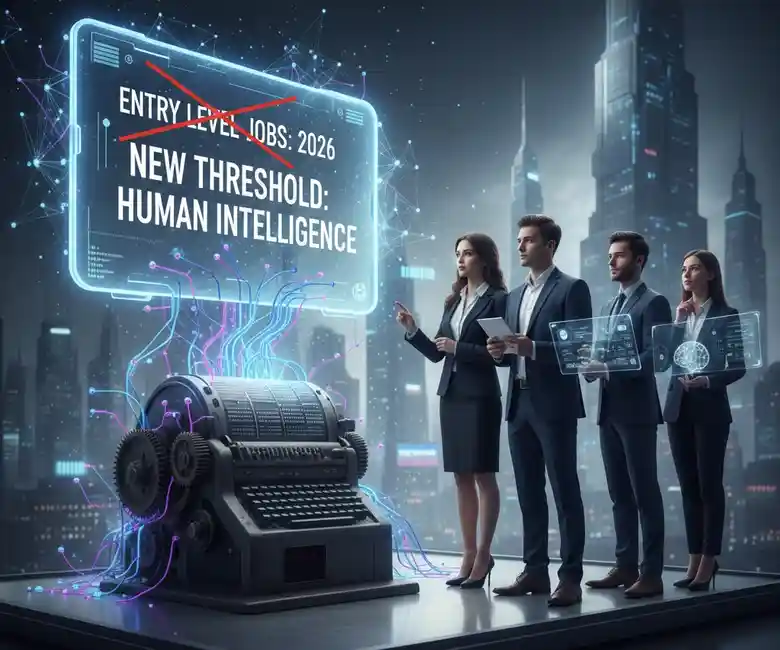
The career ladder is collapsing.
For decades, the path was predictable: graduate, start in an entry-level position doing repetitive tasks, learn the ropes, gradually take on more responsibility, eventually become senior enough to manage people. Rinse, repeat.
That ladder just got sawed in half.
Entry-level hiring at the 15 biggest tech firms fell 25% from 2023 to 2024. Entry-level job postings have dropped 15% year-over-year. Nearly 4 in 10 companies will replace workers with AI by the end of 2026. AI poses a risk of eliminating 10-20% of entry-level white-collar jobs within the next five years.
The data is unambiguous: traditional entry-level positions are disappearing at an accelerating rate.
But here's what everyone's missing: Entry-level jobs aren't being eliminated. They're being redefined.
The future entry-level position isn't doing the work, it's managing the AI that does the work.
🎯 The Paradox No One Is Talking About
AI can now perform most entry-level tasks. It can write code, analyze data, draft reports, process applications, respond to customer inquiries, and generate content. Companies are discovering they can replace junior employees with AI agents that work 24/7, never call in sick, and cost a fraction of the salary.
But here's the problem: AI still needs human oversight.
AI makes mistakes. It hallucinates facts. It misunderstands context. It generates output that sounds sophisticated but is factually wrong. It needs quality control. It needs guidance. It needs someone who understands the work well enough to know when the AI got it right and when it went completely off the rails.
"The same expertise required to do the job is the same expertise required to instruct others, or in this case, instruct AI, to do the job."
This creates a fundamental shift: The new entry-level threshold isn't "can you do the work?" It's "can you evaluate, direct, and refine AI doing the work?"
Welcome to the age of the AI Manager.
🤖 What an AI Manager Actually Does
Think of it as being a project manager for a workforce that never sleeps but also doesn't intuitively understand human context.
AI Managers are responsible for:
Prompt Engineering and Instruction Design
Crafting the specific prompts and parameters that get AI to produce the desired output. This isn't casual ChatGPT usage, it's understanding how to structure context, constraints, and clarity to eliminate ambiguity and maximize accuracy.
Quality Assurance and Evaluation
Reviewing AI-generated work to identify errors, hallucinations, bias, or misalignment with business objectives. This requires deep domain knowledge, you can't evaluate legal research if you don't understand law, and you can't validate code if you don't understand programming.
Workflow Orchestration
Designing and managing the systems that route tasks between AI agents, humans, and other tools. This means understanding business processes well enough to know where AI adds value and where human judgment is non-negotiable.
Continuous Optimization
Testing different approaches, analyzing performance metrics, and iteratively improving how AI agents perform their assigned tasks. AI Manager effectiveness compounds over time as they learn what works.
Training and Troubleshooting
Teaching AI new capabilities through examples and feedback loops, debugging when things go wrong, and maintaining the knowledge bases that AI systems rely on.
This isn't entry-level in the traditional sense. It's entry-level in the sense that it's now the minimum threshold to add value in an AI-augmented workplace.
💰 Why This Makes Perfect Economic Sense
From an employer's perspective, the math is straightforward.
Hire 5 entry-level employees at $50K each = $250K annually in salary alone (not counting benefits, office space, management overhead).
Deploy AI agents + hire 1 AI Manager at $75K to supervise = $75K annually + software costs.
That's not a 30% cost reduction. That's a 70% reduction in labor costs while potentially maintaining or even increasing output quality and speed.
The World Economic Forum reports that 40% of employers expect to reduce their workforce where AI can automate tasks. Technology is projected to be the most disruptive force in the labor market, with AI expected to create 11 million jobs while displacing 9 million others.
The displacement is real. But what's equally real is that someone still needs to manage the AI doing the work.
📊 The Skill Gap Is Already Showing
Right now, there's a massive disconnect between what companies need and what recent graduates can provide.
According to the National Association of Colleges and Employers' Job Outlook 2026 survey, employers' rating of the job market for college graduates is now at its most pessimistic since 2020. Yet companies are desperately seeking people who can effectively work with AI.
Surge in job postings referencing "AI" over the past two years
Roles like "AI Prompt Engineer" command salaries between $280,000 and $375,000 at companies like Anthropic. The demand is exploding, but the supply of qualified candidates is painfully limited.
Here's why: Universities are still training students for jobs that are disappearing while failing to prepare them for the jobs that are emerging.
"We're graduating thousands of people trained to do work that AI can now do, while struggling to find people who can manage AI doing that work."
🪜 The New Career Ladder
The traditional progression was:
- Entry-level → Learn by doing repetitive tasks
- Mid-level → Handle more complex tasks independently
- Senior-level → Make strategic decisions
- Management → Oversee people doing the work
The new progression is:
- AI Manager (Entry-level) → Supervise AI doing repetitive tasks, learn by evaluating outputs
- AI Orchestration Specialist (Mid-level) → Design and optimize multi-agent workflows, handle edge cases AI can't
- Strategic AI Architect (Senior-level) → Determine where and how AI creates competitive advantage
- AI-Augmented Leadership (Management) → Oversee both human and AI workforces in hybrid operations
Notice what's missing? The traditional entry-level position where you spend two years doing grunt work to "pay your dues" and learn the basics.
That position is being automated. The dues are now paid by learning how to make AI effective.
🧠 What This Means for Skills Development
The expertise required to be an effective AI Manager is substantially different from traditional entry-level skills.
You need domain expertise. You can't evaluate AI-generated legal research without understanding law. You can't validate AI-written code without understanding programming. You can't assess AI-generated marketing content without understanding brand voice and messaging strategy.
This creates a catch-22: Entry-level positions traditionally provided the space to develop domain expertise through low-stakes repetition. But if those positions are disappearing, how do people develop the expertise needed to manage AI?
The answer is emerging in several forms:
- Apprenticeships and structured learning programs that combine theoretical knowledge with hands-on AI management experience.
- Universities pivoting toward AI-augmented education where students learn alongside AI from day one.
- Micro-credentialing and skill-specific certifications that demonstrate ability to effectively deploy and manage AI in specific domains.
- Hybrid internship models where students simultaneously learn a domain while learning to deploy AI within that domain.
🏆 The Winners and Losers
This transition will create clear winners and losers in the job market.
- People who can demonstrate AI management capabilities regardless of formal education
- Domain experts who rapidly adopt AI oversight skills
- Recent graduates who understand that their value comes from managing AI, not competing with it
- Mid-career professionals who can bridge legacy workflows and AI-augmented processes
- New graduates expecting traditional entry-level positions as stepping stones
- People who view AI as a threat to avoid rather than a tool to master
- Companies that eliminate entry-level positions without building pathways for developing AI Managers
- Industries that delay AI adoption while competitors race ahead
The particularly cruel aspect: The generation entering the workforce right now, graduates of 2024, 2025, and 2026, is caught in the worst possible timing. They trained for jobs that are being automated before they can even land them.
🌍 The Future Is Already Here
Some companies are already operating in this new reality.
IBM's AskHR system handles 11.5 million interactions annually with minimal human oversight. Microsoft reports that 30% of their code is now AI-written. Major banks expect to cut approximately 200,000 jobs over the next 3-5 years as AI automates loan processing, compliance checks, and customer service.
But these same companies still need humans. They need AI Managers who can:
- Design the prompts that make customer service chatbots actually helpful
- Evaluate the code that AI generates to ensure it's production-ready
- Assess the loan applications that AI flags for manual review
- Monitor the compliance systems that AI operates to catch errors
The work isn't disappearing. The nature of the work is fundamentally changing.
🎯 How to Position Yourself for This Reality
If you're entering the workforce or early in your career, here's what matters now:
1. Stop thinking about "AI-proof" careers
There's no such thing. Every profession will be transformed by AI. The question isn't whether your industry will be affected, it's whether you'll be managing AI or competing with it.
2. Develop domain expertise alongside AI management skills
You need to understand both the work itself and how to effectively deploy AI to do that work. One without the other leaves you either irrelevant or incompetent.
3. Learn prompt engineering and AI evaluation
These aren't specialized technical skills, they're becoming baseline requirements across all knowledge work. Understanding how to structure effective prompts, evaluate outputs, and iteratively refine AI performance is the new literacy.
4. Build a portfolio of AI-managed projects
Don't just list that you've used ChatGPT on your resume. Demonstrate that you've designed, deployed, and optimized AI agents to solve real business problems and can quantify the results.
5. Embrace the hybrid identity
You're not competing against AI, you're partnering with it. The most valuable workers will be those who can seamlessly orchestrate both human and AI capabilities to achieve outcomes neither could accomplish alone.
💡 The Uncomfortable Truth
AI isn't replacing entry-level jobs because it's better at doing entry-level work.
AI is replacing entry-level jobs because companies discovered they can get better results by hiring one person who can manage AI than by hiring five people who can't.
The entry-level job isn't dead. It's evolved.
The new entry-level job is AI Manager. The new minimum qualification is the ability to effectively evaluate, direct, and optimize AI agents performing the work that used to be done by entry-level employees.
"The same expertise required to do the job is now the same expertise required to manage AI doing the job."
This isn't the future. This is happening right now.
The question isn't whether you'll work alongside AI. The question is whether you'll be the one directing it, or the one it's replacing.
The career ladder hasn't disappeared. It's just that the first rung is now significantly higher than it used to be.
Can you reach it?
Ready to position yourself for the AI-managed future? Let's discuss how to build the skills and systems that matter.
Book Free Strategy Call →About the Author: Perry Luzier is the founder of Luzran LLC, an AI consulting and business transformation company that helps businesses navigate the shift to AI-augmented operations through strategic automation and workforce optimization.